homesy

Inventing consumer-powered real estate
In the spring of 2020, America faced converging crises: COVID and the Black Lives Matter protests after the murder of George Floyd. For a moment, escape to far off Zoomtowns seemed reasonable, until another crisis emerged beneath the misery: a real estate market gutted by record-low inventory, skyrocketing prices, and a steady stream of antitrust actions and ugly publicity about the real estate industry.
Homesy was my answer to this crisis—an attempt to shift power from the industry to consumers by building a peer-to-peer home discovery platform, without excluding brokers. But what I learned—and what every company peering into the future of agentic AI needs to see—is how difficult it is to differentiate when industries consolidate and commoditize data.
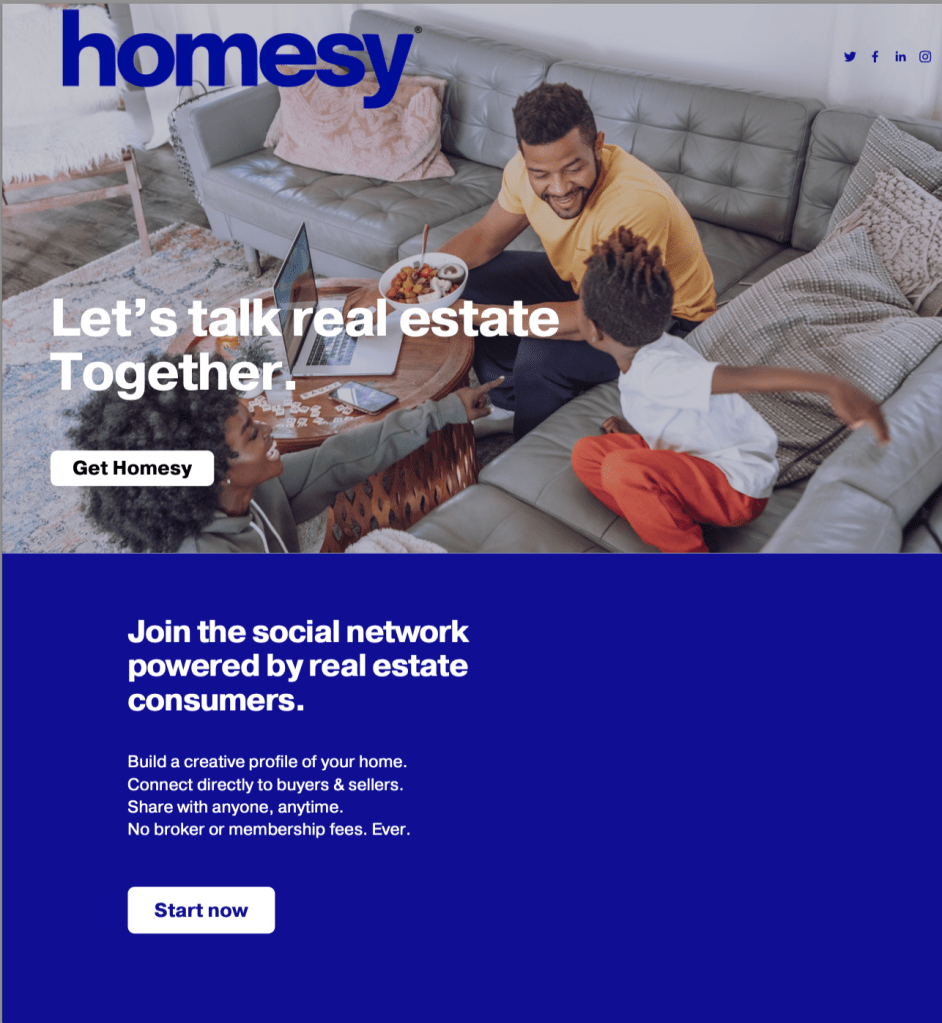
Homesy’s homepage
Homesy tried to solve this problem (before AI) through a simple solution and value proposition: a platform on which sellers, buyers, and even renters could build up the data and stories of their homes, saving time, money, and the stress of being solely reliant on brokers for making real estate decisions.
How Homesy Worked
Legacy portals restrict searches to beds, baths, price and location. Their listings are ads for broker inventory. But Homesy put the spotlight on tools to tell the story of your home—or your search for a home—in as much detail as you wanted. Profiles including living rooms, garages, basements, home offices, kitchens, etc., and even the core amenities of those rooms (windows, closets, floors and major appliances). A social feed to meet sellers (or buyers) in your vicinity. A scrapbook for saving all your favorite homes. All of it, multimodal, including photos, videos, floorplans and simple storytelling.
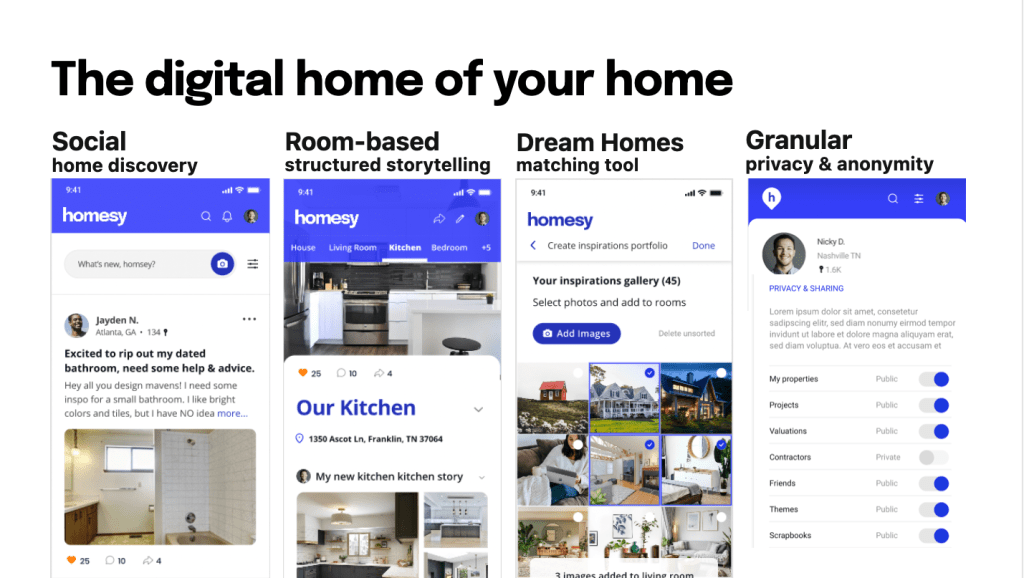
A page from Homesy’s deck showing some of its features and design
Buyers, sellers, renters (even brokers) could build a 24/7 real-time platform to test prices, line-up prospects before listing, get deep comps (even against rentals), search across multiple locations, and create exponentially more data than you could get from a single broker. You—not the broker— would be the owner of this data, and the more you posted, the more you’d be rewarded with reach and rewards, captured in a private wallet, an idea that won us a coveted spot in Polkadot’s 2023 Relayers Incubator.

Click on the image at left to read the full manifesto.
Why me
This was personal. I was hired as editorial director of mortgage.com when Citi Real Estate Lending (REL) got the URL as part of a $7 billion deal for mortgage assets it had bought from ABN Amro. After about a year, however, it became clear that Citi was the canary in the subprime coal mine. I was out of a job, near foreclosure, with twin babies in a big new apartment. Sixteen excruciating months later, I landed as editor in chief of AOL Real Estate.
I got that job not because I was a broker, but because I was a consumer with firsthand knowledge of how the tight real estate market was squeezing middle class buyers and sellers, especially younger people and people of color. I saw countless examples of value left on the table because of the industry’s frictions.
Digital natives have long had platforms that brought them together through user-generated data to find jobs (LinkedIn), places to stay (Airbnb), meet cute (Match), or share investment strategies (Public). These platforms work because they put user-generated data before relationships; relationships are made through algorithmic matching. But in real estate, data takes a back seat to transaction and relationships. Real estate has it backwards.

Homesy’s End
Homesy inverted this story. Everyone has a real estate story, we said. Now you have a place to tell it. But, we didn’t.
While early tests showed promise, building a two-sided marketplace is tricky. Our prototype was over-developed, testing stalled, data costs skyrocketed, angel money ran out. Without scale, our efforts to differentiate the data were ineffective. Investors ignored us. Regulatory change as a result of the DOJ’s massive antitrust victories against the National Association of Realtors drew shrugs. And creating broad community in an industry that is inherently hyperlocal proved to be difficult. The market spoke. We were premature at best—and then generative AI arrived, changing every business model. Homesy needed to evolve, pivot, or close. It was time to move on.
Here’s what I’ve learned: Data is the oil of every industry vertical and the brands with the weakest data will soon become extinct. Every time an agent finds better content or better deals than intermediaries, customers will walk—no matter how strong your relationship is. And while you can dress up a chatbot to proactively personalize customer experience (a wrapper), you can bet on there always being another agent with superior prompt engineering to poach your customers. What’s needed is ARC: Access to creating or editing data; Responsiveness to consumer needs that’s not time limited; and Co-Creation with other humans (including professionals). These are the keys to differentiation in a world of agentic competition.
If your business model depends on consumers tolerating information assymetries, high transaction costs, or industry frictions that make purchase decisions painful—agentic AI will disrupt you. The question isn’t whether, but when and how you adapt. I help companies wrestle with these questions and find solutions that amplify their competitive advantages. See how I can help.
Curious to hear more? Visit my new Substack about the disruption of agency and the future of consumer real estate, at a new Substack, Burning Down the House. Subscribe here.
